
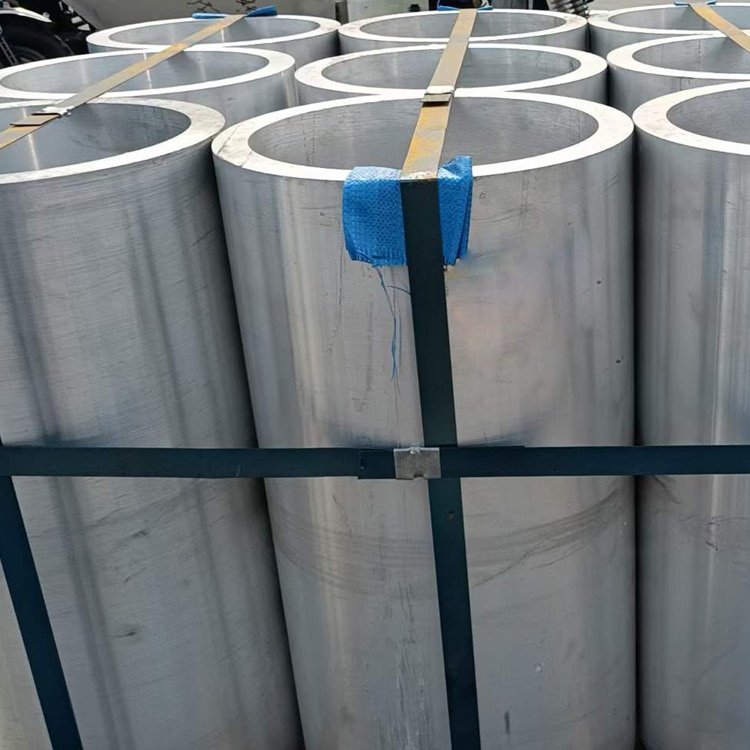
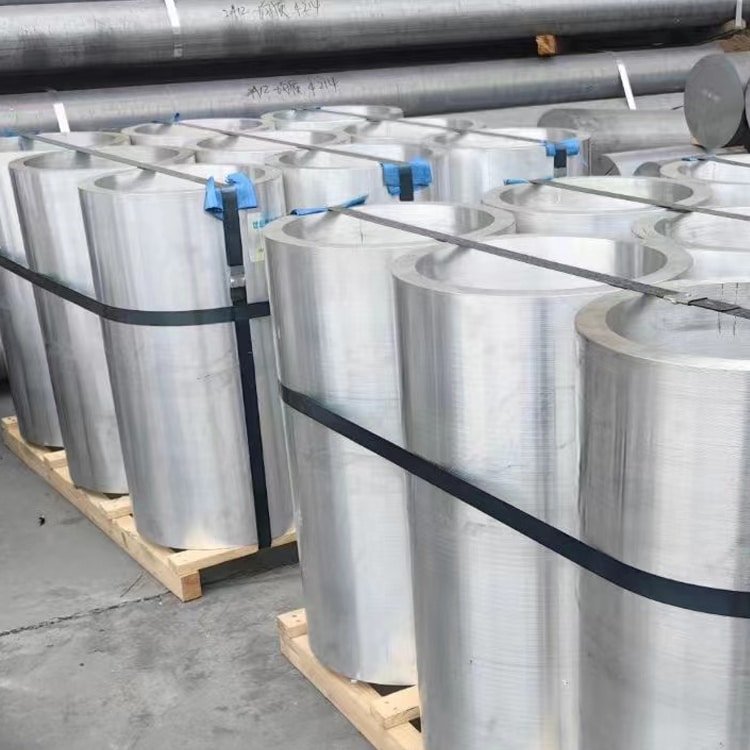
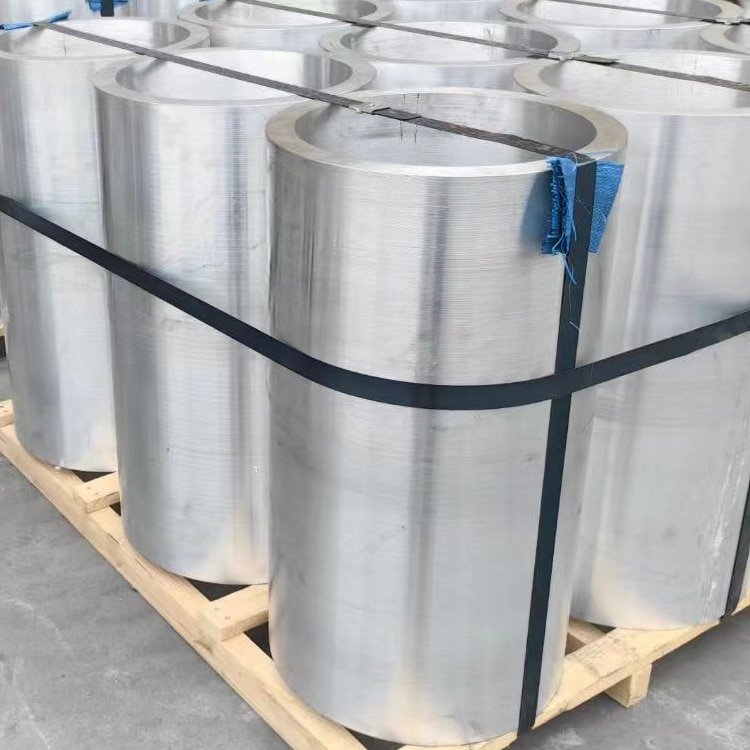
1. Material Composition & Forging Process
5083 marine-grade aluminum forging pipes comply with ASTM B247, EN 754-2, and NORSOK M-121 standards with optimized magnesium-manganese composition for seawater corrosion resistance:
Primary Alloying Elements:
- Magnesium (Mg): 4.0-4.9% (enhances strength and corrosion resistance)
- Manganese (Mn): 0.4-1.0% (controls grain structure)
- Chromium (Cr): 0.05-0.25% (improves stress corrosion cracking resistance)
Base Material:
- Aluminum (Al): ≥93.5% (balance)
Impurity Limits:
- Iron (Fe): ≤0.40% max
- Silicon (Si): ≤0.40% max
- Copper (Cu): ≤0.10% max (critical for marine corrosion)
- Zinc (Zn): ≤0.25% max
Marine-Specific Forging Process:
- Preheating: 380-420°C in controlled atmosphere furnaces
- Forging Parameters:
- Temperature range: 320-380°C
- Reduction ratio: ≥3:1 (guarantees grain refinement)
- Strain rate: 1-10 s⁻¹
- Directional grain flow: Longitudinal orientation ±8°
- Multi-Directional Forging: Three-axis hydraulic presses (15,000-30,000 tons)
- Post-Forging Treatment:
- Controlled cooling: 30°C/min max cooling rate
- Straightening tolerance: ≤0.5mm/m
Certified to DNV GL OS F101 and ABS Guide for Aluminum Structures with full traceability from billet to finished product.
2. Mechanical Properties in Marine Conditions
H116/H321 tempers provide superior seawater performance:
| Property | H116 Temper | H321 Temper | Test Standard |
| Tensile Strength | 275-350 MPa | 300-370 MPa | ASTM E8 |
| Yield Strength (Rp0.2) | 125-185 MPa | 215-265 MPa | ASTM E8 |
| Elongation in Seawater | 16-22% | 10-16% | ASTM G44/G49 |
| Fracture Toughness KIC | 35 MPa√m | 30 MPa√m | ASTM E399 |
| Corrosion Fatigue Limit | 110 MPa (10⁷ cyc) | 140 MPa (10⁷ cyc) | ASTM E466 |
| Impact Toughness (-40°C) | 35-45 J | 28-35 J | ISO 148 |
| Stress Corrosion Threshold | 100 MPa | 150 MPa | ASTM G64 |
| Critical Pitting Temp | 65°C | 75°C | ASTM G48 |
Maintains ≥80% mechanical properties after 20-year seawater exposure simulations per ASTM G50.
3. Heat Treatment & Microstructure
Specialized tempering for marine applications:
H116 Stabilization Process:
- Solution Treatment: 415°C ±10°C for 1.5-3 hours
- Rapid Water Quench: Cooling rate >100°C/sec
- Stabilization: 150°C for 4 hours + 100°C for 12 hours
H321 Work Hardening Process:
- Controlled rolling at 250-300°C with 15-25% thickness reduction
- Final stabilization: 120°C/8 hours
Microstructural Characteristics:
- Grain size: ASTM 6-8 (15-35μm)
- Intermetallic phases: Al6(Mn,Fe) dispersoids (0.1-0.3μm)
- Phase distribution: <5% β-phase (Al3Mg2)
- Dislocation density: 5×10⁹/cm² (H321)
- Grain boundary precipitate coverage: <25nm continuous
4. Dimensions & Marine-Specific Configurations
| Parameter | Standard Range | Shipbuilding Tolerance | Special Profiles |
| Outer Diameter | 50-1200 mm | ±0.1% OD | Oval/rectangular |
| Wall Thickness | 6-80 mm | +10%/-5% WT | Tapered/stepped |
| Length | 3-18 m | +5mm/-0mm | Up to 30m coiled |
| Ovality | ≤1.0% | ≤0.3% for risers | - |
| Bend Radius | 1.5× OD | 1.0× OD with mandrel | - |
| Straightness | 1.0mm/m | 0.3mm/m (high-pressure) | - |
Marine Fabrication Technologies:
- Closed-die forging for complex flanges
- Radial forging for uniform wall thickness
- Roll bending for hull penetrations
- Explosive forming for special contours
- CNC ring rolling for manifold sections
5. Corrosion Performance in Marine Environments
| Exposure Condition | Corrosion Rate (mm/yr) | Test Duration | Protection Method |
| Splash Zone (tidal) | 0.01-0.03 | 5-year study | 200μm HVOF coating |
| Seawater Immersion | 0.02-0.05 | ASTM G31 | Cathodic protection |
| Mud Zone | 0.005-0.015 | ISO 11306 | PE 3-layer coating |
| High-Velocity Seawater (4m/s) | 0.03-0.08 | ASTM G119 | Electropolishing |
| Marine Atmosphere | 0.001-0.003 | ISO 9223 | Anodizing (AA25) |
Advanced Marine Protection Systems:
- Anodic Protection:
- Zinc bracelet systems per DNV-RP-B401
- Aluminum-zinc-indium alloy anodes
- Coatings:
- Glassflake epoxy: 500-1000μm DFT
- Impressed Current Cathodic Protection (ICCP)
- Metal Spray:
- 85/15 Zinc-Aluminum spray (150-250μm)
- Lining Systems:
- High-density polyethylene (HDPE) lining
- Elastomeric polyurethane linings
6. Machinability for Marine Components
| Operation | Tool Material | Parameters | Marine Applications |
| Underwater Cutting | Ceramic Inserts | 90-120m/min feed | Repair works |
| Deep Hole Drilling | Carbide Gundrills | 30-50m/min, peck cycle | Hydraulic passages |
| CNC Milling | TiAlN Coated Tools | 400-600m/min | Flange machining |
| Tapping | Spiral Point Taps | 15-20m/min | Pipe connections |
| Boring | Damped Boring Bars | 100-200m/min | Stern tube machining |
Machining Characteristics:
- Built-up edge tendency: Low (grade B per ISO 3685)
- Surface finish achievable: Ra 0.8-3.2μm
- Cutting fluid: Water-soluble synthetics (pH 8.5-9.0)
- Chip control: Excellent - forms continuous chips
- Tool life: 70% longer than steel components
7. Marine Welding & Joining Technology
Recommended Welding Processes:
- GMAW-P (Pulsed MIG):
- Filler: ER5183/ER5356
- Shielding gas: Ar+30%He
- Heat input: ≤1.2 kJ/mm
- Friction Stir Welding:
- Tool rotation: 400-600 RPM
- Traverse speed: 100-300mm/min
- Axial force: 15-35kN
Critical Joint Types:
- Collar Joints:
- 35-45° bevel angles
- Double-sided welding for full penetration
- Mechanical Couplings:
- Victaulic-style grooves
- 316L stainless steel clamps
- Adhesive Bonding:
- Epoxy polysulfide sealants
- 25-35MPa shear strength in seawater
8. Physical Properties
| Property | Value | Marine Significance |
| Density | 2.66 g/cm³ | 35% lighter than steel |
| Thermal Conductivity | 117 W/m·K | Cryogenic applications |
| Electrical Resistivity | 49 nΩ·m | Lightning protection |
| Melting Range | 570-640°C | Fire safety rating |
| Modulus of Elasticity | 71 GPa | Structural flexibility |
| CTE (20-100°C) | 23.8 μm/m·°C | Thermal expansion control |
| Magnetic Permeability | 1.000022 | Degaussing systems |
| Acoustic Impedance | 17.5 MRayl | Sonar transparency |
9. Marine Certification & Testing
Rigorous Quality Verification
- Corrosion Testing:
- EXCO testing per ASTM G34
- 1000hr salt spray per ASTM B117
- Galvanic corrosion testing per ASTM G71
- Mechanical Testing:
- Full-scale hydrostatic testing (6,000psi)
- Charpy V-notch testing at -196°C
- NDE Requirements:
- Automated UT with TOFD capability
- Digital radiography per EN 13068
- Alternating Current Field Measurement
Marine Certifications
- DNV GL Type Approval Certificate
- ABS Marine Vessel Approval
- Lloyd's Register Marine Component Certificate
- NORSOK M650 Qualification
- MIL-DTL-24196 for shipboard systems
- FDA Subchapter D - Food contact in galleys
10. Applications in Marine Engineering
Primary Marine Applications:
- Offshore platform structural members
- Seawater cooling pipe systems
- Marine riser tensioner systems
- Liquid natural gas (LNG) transfer lines
- Ballast water management systems
- Naval vessel superstructures
- Subsea umbilical conduits
- Desalination plant components
Handling & Packaging:
- VCI polyfilm wrapping + desiccant
- Wooden crates with ISO markings
- Coastal corrosion protection compound coating
- Seaworthiness certificate for ocean transport