 Skip to content

1. Material Overview & Manufacturing Process
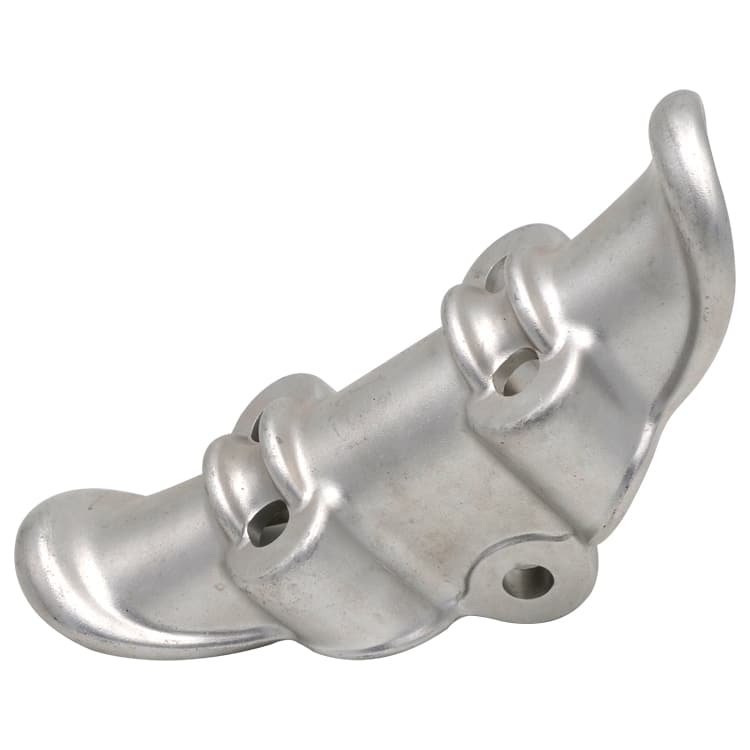
Aluminum alloy aviation die forging parts are critical structural components in the aerospace industry, renowned for their exceptional strength-to-weight ratio, high reliability, excellent fatigue performance, and impact resistance. These components are manufactured through precisely controlled die forging processes, maximizing the advantages of high-performance aerospace aluminum alloys (such as 2xxx and 7xxx series). The forging process refines the internal grains of the material, densifies its structure, and creates continuous grain flow lines that closely conform to the part's geometry, thereby significantly enhancing the load-bearing capacity and safety of parts under complex loads.
- Common Aerospace Aluminum Alloy Grades and Their Characteristics:
- 2xxx Series (Al-Cu-Mg System):
- Typical Grades: 2014, 2024, 2618.
- Characteristics: High strength, excellent fatigue performance, good fracture toughness. 2024 is one of the most widely used grades. 2618 alloy maintains good strength at elevated temperatures.
- Primary Alloying Elements: Copper (Cu), Magnesium (Mg), Manganese (Mn).
- 7xxx Series (Al-Zn-Mg-Cu System):
- Typical Grades: 7050, 7075, 7475.
- Characteristics: Ultra-high strength, very high yield strength, the strongest aluminum alloys in aerospace applications. 7050 and 7475 offer better fracture toughness and resistance to stress corrosion cracking (SCC) than 7075 while maintaining high strength.
- Primary Alloying Elements: Zinc (Zn), Magnesium (Mg), Copper (Cu), Chromium (Cr) or Zirconium (Zr).
- 8xxx Series (Al-Li System):
- Typical Grades: 2099, 2195, 2050.
- Characteristics: Next-generation aerospace alloys with lower density and higher modulus, significantly improving strength-to-weight and stiffness-to-weight ratios, while maintaining excellent fatigue performance and damage tolerance.
- Primary Alloying Elements: Lithium (Li), Copper (Cu), Magnesium (Mg), Zinc (Zn).
- Base Material:
- Aluminum (Al): Balance
- Controlled Impurities:
- Strict control of impurity elements such as iron (Fe) and silicon (Si) is maintained to ensure high metallurgical cleanliness, preventing the formation of harmful coarse intermetallic compounds, thereby optimizing mechanical properties and damage tolerance.
Manufacturing Process (for Aerospace Die Forgings): The production process for aerospace die forgings is extremely rigorous and complex, requiring precise control at every stage to ensure the highest quality and reliability of products, meeting the stringent standards of the aviation industry.
- Raw Material Selection and Certification:
- Aerospace grade forging billets are selected. All raw materials must be provided with complete traceability documentation, including heat number, chemical composition, internal grain size, ultrasonic inspection reports, etc.
- Strict chemical composition analysis ensures compliance with aerospace standards such as AMS, MIL, BAC, ASTM.
- Cutting and Pre-treatment:
- Billets are precisely calculated and cut according to the complex geometric shape and final dimensional requirements of the part. Pre-heat treatment may be involved to optimize billet plasticity.
- Heating:
- Billets are precisely heated in advanced forging furnaces with extremely high temperature uniformity. Furnace temperature uniformity must comply with AMS 2750E Class 1 or 2 standards to prevent local overheating or underheating. The heating process is often conducted under an inert atmosphere or with special coating protection to reduce oxidation.
- Die Forging Formation:
- Multi-pass die forging is performed using large hydraulic presses or forging hammers. Advanced CAE simulation techniques (e.g., DEFORM) are used in die design to precisely predict metal flow, ensuring grain flow lines align with the part's main stress directions, avoiding folds, incomplete filling, or transverse grain flow.
- Pre-forging, Finish Forging, and Precision Forging: Typically involves complex steps of pre-forging (preparing a rough blank), finish forging (fine shaping), and precision forging (high-accuracy, near-net shaping). Each step strictly controls deformation amount, deformation rate, and temperature to optimize internal structure.
- Trimming and Punching:
- After forging, excess flash around the periphery of the forging is removed. For parts with internal cavities or holes, punching operations may be required.
- Heat Treatment:
- Solution Heat Treatment: Performed at precisely controlled temperature and time to ensure complete dissolution of alloying elements. Temperature uniformity (±3°C) and quench transfer time (typically less than 15 seconds) are critical.
- Quenching: Rapid cooling from the solutionizing temperature, typically by water quenching or polymer quenching. For large-sized or complex-shaped parts, stepped quenching or delayed quenching may be used to reduce residual stress or distortion.
- Aging Treatment: Single-stage or multi-stage artificial aging is performed according to the alloy grade and final performance requirements.
- T6 Temper: Provides maximum strength.
- T73/T7351/T7451/T7651 Tempers: For 7xxx series, overaging is used to improve resistance to stress corrosion cracking (SCC) and exfoliation corrosion, which is a mandatory requirement for aerospace applications.
- Stress Relief:
- After heat treatment, forgings are typically subjected to tensile or compression stress relief (e.g., Txx51 series) to significantly reduce quenching residual stress, minimize subsequent machining distortion, and improve dimensional stability.
- Finishing & Inspection:
- Deburring, shot peening (improves surface fatigue performance), surface quality checks, dimensional inspection.
- Comprehensive nondestructive testing and mechanical property tests are performed to ensure the product complies with aerospace standards.
2. Mechanical Properties of Aluminum Alloy Aviation Die Forging Parts
The mechanical properties of aluminum alloy aviation die forging parts are key to their widespread use in the aerospace industry. These properties have strict specified values in longitudinal (L), transverse (LT), and short-transverse (ST) directions to ensure effective control of anisotropy.
| Property Type | 2024-T351 Typical Value | 7050-T7451 Typical Value | 7075-T7351 Typical Value | 2050-T851 Typical Value | Test Direction | Standard |
| Ultimate Tensile Strength (UTS) | 440-480 MPa | 500-540 MPa | 480-520 MPa | 550-590 MPa | L/LT/ST | ASTM B557 |
| Yield Strength (0.2% YS) | 300-330 MPa | 450-490 MPa | 410-450 MPa | 510-550 MPa | L/LT/ST | ASTM B557 |
| Elongation (2 inch) | 10-18% | 8-14% | 10-15% | 8-12% | L/LT/ST | ASTM B557 |
| Brinell Hardness | 120-135 HB | 145-160 HB | 135-150 HB | 165-180 HB | N/A | ASTM E10 |
| Fatigue Strength (10⁷ Cycles) | 140-160 MPa | 150-180 MPa | 140-170 MPa | 170-200 MPa | N/A | ASTM E466 |
| Fracture Toughness K1C | 30-40 MPa√m | 35-45 MPa√m | 28-35 MPa√m | 30-40 MPa√m | N/A | ASTM E399 |
| Shear Strength | 270-300 MPa | 300-330 MPa | 280-310 MPa | 320-350 MPa | N/A | ASTM B769 |
| Young's Modulus | 73.1 GPa | 71 GPa | 71 GPa | 74.5 GPa | N/A | ASTM E111 |
Property Uniformity and Anisotropy:
- Aerospace die forgings have strict requirements for property uniformity and anisotropy. Through advanced forging processes and die design, grain flow can be precisely controlled to achieve optimal properties in critical loading directions.
- Aerospace standards typically set clear minimum guaranteed values for mechanical properties in L, LT, and ST directions, ensuring that the part has sufficient strength and toughness in all orientations.
3. Microstructural Characteristics
The microstructure of aluminum alloy aerospace die forgings is the fundamental guarantee of their high strength, toughness, fatigue performance, and damage tolerance.
Key Microstructural Features:
- Refined, Uniform, and Dense Grain Structure:
- The forging process completely breaks down coarse as-cast grains, forming fine, uniform, and dense recrystallized grains, and eliminating casting defects like porosity and shrinkage. Average grain size is usually strictly controlled within a specific range to optimize overall mechanical properties.
- Dispersoids formed by alloying elements such as Cr, Mn, and Zr (in some grades) effectively pin grain boundaries, inhibiting excessive grain growth and recrystallization.
- Continuous Grain Flow Highly Conforming to Part Shape:
- This is the core advantage of aerospace die forgings. As the metal plastically flows within the die cavity, its grains are elongated and form continuous fibrous flow lines that closely conform to the part's complex external and internal structures.
- This grain flow alignment with the part's primary stress direction under actual operating conditions effectively transfers loads, significantly improving the part's fatigue performance, impact toughness, fracture toughness, and stress corrosion cracking resistance in critical areas (e.g., corners, connection holes, varying cross-sections).
- Precise Control of Strengthening Phases (Precipitates):
- After solution heat treatment and multi-stage aging, strengthening phases (e.g., Al₂CuMg, MgZn₂) precipitate uniformly in the aluminum matrix with optimal size, morphology, and distribution.
- For 7xxx series, aging treatments (e.g., T73, T74, T76 tempers) aim to effectively improve stress corrosion cracking (SCC) and exfoliation corrosion resistance by controlling the type of precipitates and the morphology of grain boundary precipitates (coarsening, discontinuity), even at the expense of some peak strength.
- High Metallurgical Cleanliness:
- Strict control of impurity elements such as iron (Fe) and silicon (Si) avoids the formation of coarse, brittle intermetallic compounds, thereby ensuring the material's toughness, fatigue life, and damage tolerance. Aerospace forgings typically require extremely low levels of non-metallic inclusions.
4. Dimensional Specifications & Tolerances
Aluminum alloy aerospace die forgings usually require high precision and strict dimensional tolerances to minimize subsequent machining, reducing costs and lead times.
| Parameter | Typical Size Range | Aerospace Forging Tolerance (e.g., AMS 2770) | Precision Machining Tolerance | Test Method |
| Max Envelope Dimension | 100 - 3000 mm | ±0.5% or ±1.5 mm | ±0.02 - ±0.2 mm | CMM/Laser Scan |
| Min Wall Thickness | 3 - 100 mm | ±0.8 mm | ±0.1 - ±0.3 mm | CMM/Thickness Gauge |
| Weight Range | 0.1 - 500 kg | ±3% | N/A | Electronic Scale |
| Surface Roughness (Forged) | Ra 6.3 - 25 μm | N/A | Ra 0.8 - 6.3 μm | Profilometer |
| Flatness | N/A | 0.25 mm/100mm | 0.05 mm/100mm | Flatness Gauge/CMM |
| Perpendicularity | N/A | 0.25° | 0.05° | Angle Gauge/CMM |
Customization Capability:
- Aerospace die forgings are typically highly customized, designed and produced based on 3D models (CAD files) and detailed engineering drawings provided by aircraft manufacturers.
- Manufacturers possess full capabilities from die design, forging, heat treatment, stress relief to final precision machining and surface treatment.
5. Temper Designations & Heat Treatment Options
The properties of aerospace aluminum alloys are entirely dependent on precise heat treatment. Aerospace standards have extremely strict regulations for the heat treatment process.
| Temper Code | Process Description | Typical Applications | Key Characteristics |
| O | Fully annealed, softened | Intermediate state before further processing | Maximum ductility, easy for cold working |
| T3/T351 | Solution heat treated, cold worked, naturally aged, stretched stress-relieved | 2xxx series, high strength, high damage tolerance | High strength, good toughness, reduced residual stress |
| T4 | Solution heat treated, then naturally aged | Applications not requiring maximum strength, good ductility | Moderate strength, used for parts requiring high formability |
| T6/T651 | Solution heat treated, artificially aged, stretched stress-relieved | 6xxx series general high strength, 7xxx series highest strength (but SCC sensitive) | High strength, high hardness, low residual stress |
| T73/T7351 | Solution heat treated, overaged, stretched stress-relieved | 7xxx series, high SCC resistance, high damage tolerance | High strength, optimal SCC resistance, low residual stress |
| T74/T7451 | Solution heat treated, overaged, stretched stress-relieved | 7xxx series, better SCC resistance than T6, lower than T73, higher strength than T73 | Good SCC and exfoliation resistance, high strength |
| T76/T7651 | Solution heat treated, overaged, stretched stress-relieved | 7xxx series, better exfoliation resistance than T73, moderate SCC resistance | Good exfoliation resistance, high strength |
| T8/T851 | Solution heat treated, cold worked, artificially aged, stretched stress-relieved | 2xxx series Li-alloys, highest strength and modulus | Ultimate strength and stiffness, low residual stress |
Temper Selection Guidance:
- 2xxx Series: Often selected in T351 (e.g., 2024) or T851 (e.g., 2050, 2099) tempers to achieve excellent fatigue performance and damage tolerance.
- 7xxx Series: Depending on the requirements for stress corrosion cracking (SCC) and exfoliation corrosion, T7351, T7451, or T7651 tempers are chosen, sacrificing some peak strength to ensure long-term reliability. 7075 in T6 temper is rarely used directly for primary aerospace load-bearing structures.
6. Machining & Fabrication Characteristics
Aerospace aluminum alloy die forgings usually require extensive precision machining to achieve the complex geometries and high dimensional accuracy of the final part.
| Operation | Tool Material | Recommended Parameters | Comments |
| Turning | Carbide, PCD tools | Vc=200-800 m/min, f=0.1-1.0 mm/rev | High speed, high feed, ample cooling, anti-built-up edge |
| Milling | Carbide, PCD tools | Vc=300-1500 m/min, fz=0.08-0.5 mm | High-speed spindle, high-rigidity machine, attention to chip evacuation, multi-axis machining |
| Drilling | Carbide, Coated HSS | Vc=50-200 m/min, f=0.05-0.3 mm/rev | Dedicated drills, through-coolant preferred, strict hole tolerance |
| Tapping | HSS-E-PM | Vc=10-30 m/min | Quality cutting fluid, prevents thread tearing, high dimensional accuracy required |
| Welding | Fusion welding not recommended | 2xxx/7xxx series have poor fusion weldability, prone to cracking and strength loss | Aerospace parts prioritize mechanical joining or FSW; post-heat treatment repair welding is rare |
| Surface Treatment | Anodizing, Conversion Coating, Shot Peening | Anodizing (sulfuric/chromic acid), suitable for corrosion protection and coating adhesion | Shot peening improves fatigue life, diverse coating systems |
Fabrication Guidance:
- Machinability: Aerospace aluminum alloy forgings generally have good machinability, but high-strength grades (e.g., 7xxx, 8xxx series) require higher cutting forces, demanding high-rigidity machine tools and specialized cutting tools. Multi-axis machining is common.
- Residual Stress Management: Forgings, especially after quenching, have internal residual stresses. Aerospace parts often use the Txx51 (tensile stress-relieved) temper. During machining, strategies like symmetric cutting and layered cutting should be employed, and consideration given to rough machining after heat treatment, then stress relief, followed by precision machining.
- Weldability: Traditional fusion welding is rarely used for primary aerospace load-bearing aluminum alloy components. They primarily rely on mechanical joining (e.g., Hi-Lok fasteners, riveting) or solid-state welding techniques (e.g., friction welding, friction stir welding FSW), and welding usually requires localized heat treatment to restore properties.
- Quality Control: Strict in-process and off-line inspection of dimensions, geometric tolerances, surface roughness, and defects during machining.
7. Corrosion Resistance & Protection Systems
The corrosion resistance of aerospace aluminum alloys is one of their critical performance indicators, particularly considering their resistance to stress corrosion cracking (SCC) and exfoliation corrosion in different environments.
| Corrosion Type | 2xxx Series (T351) | 7075 (T6) | 7075 (T7351) | 2050 (T851) | Protection System |
| Atmospheric Corrosion | Good | Good | Excellent | Good | Anodizing, or no special protection needed |
| Seawater Corrosion | Moderate | Moderate | Good | Moderate | Anodizing, high-performance coatings, galvanic isolation |
| Stress Corrosion Cracking (SCC) | Moderately Sensitive | Highly Sensitive | Very Low Sensitivity | Very Low Sensitivity | Select T7351/T851 temper, or cathodic protection |
| Exfoliation Corrosion | Very Low Sensitivity | Moderately Sensitive | Very Low Sensitivity | Very Low Sensitivity | Select specific temper, surface coating |
| Intergranular Corrosion | Very Low Sensitivity | Moderately Sensitive | Very Low Sensitivity | Very Low Sensitivity | Heat treatment control |
Corrosion Protection Strategies:
- Alloy and Temper Selection: In aerospace, for high-strength aluminum alloys, overaged tempers (e.g., T7351/T7451/T7651 for 7xxx series, T851 for 8xxx series) with high SCC and exfoliation corrosion resistance are typically mandatory, even at the expense of some peak strength.
- Surface Treatment:
- Anodizing: The most common and effective protection method, forming a dense oxide film on the forging surface, enhancing corrosion and wear resistance. Chromic acid anodizing (CAA) or sulfuric acid anodizing (SAA) are commonly used, followed by sealing.
- Chemical Conversion Coatings: Serve as good primers for paints or adhesives, providing additional corrosion protection.
- High-Performance Coating Systems: Epoxy, polyurethane, or other high-performance anti-corrosion coatings are applied in specific or harsh environments.
- Galvanic Corrosion Management: When in contact with incompatible metals, strict isolation measures (e.g., non-conductive gaskets, insulating coatings, sealants) must be taken to prevent galvanic corrosion.
8. Physical Properties for Engineering Design
The physical properties of aluminum alloy aerospace die forgings are critical input data in aircraft design, affecting the aircraft's structural weight, performance, and safety.
| Property | 2024-T351 Value | 7050-T7451 Value | 7075-T7351 Value | 2050-T851 Value | Design Consideration |
| Density | 2.78 g/cm³ | 2.80 g/cm³ | 2.81 g/cm³ | 2.68 g/cm³ | Lightweight design, center of gravity control |
| Melting Range | 500-638°C | 477-635°C | 477-635°C | 505-645°C | Heat treatment and welding window |
| Thermal Conductivity | 121 W/m·K | 130 W/m·K | 130 W/m·K | 145 W/m·K | Thermal management, heat dissipation design |
| Electrical Conductivity | 30% IACS | 33% IACS | 33% IACS | 38% IACS | Electrical conductivity, lightning strike protection |
| Specific Heat | 900 J/kg·K | 960 J/kg·K | 960 J/kg·K | 920 J/kg·K | Thermal inertia, thermal shock response calculation |
| Thermal Expansion (CTE) | 23.2 ×10⁻⁶/K | 23.6 ×10⁻⁶/K | 23.6 ×10⁻⁶/K | 22.0 ×10⁻⁶/K | Dimensional changes due to temperature variations, connection design |
| Young's Modulus | 73.1 GPa | 71 GPa | 71 GPa | 74.5 GPa | Structural stiffness, deformation, and vibration analysis |
| Poisson's Ratio | 0.33 | 0.33 | 0.33 | 0.33 | Structural analysis parameter |
| Damping Capacity | Low | Low | Low | Low | Vibration and noise control |
Design Considerations:
- Ultimate Strength-to-Weight and Stiffness-to-Weight Ratios: Aerospace aluminum forgings are central to achieving aircraft lightweighting and high structural efficiency, with Li-alloys (8xxx series) excelling in this regard.
- Damage Tolerance Design: Beyond strength, aerospace parts prioritize damage tolerance and fatigue performance, requiring materials to perform safely even with existing flaws. The fine grains and continuous grain flow of forgings are crucial for this.
- Operating Temperature Range: Aerospace aluminum alloys are not highly temperature resistant, typically limited to operating temperatures below 120-150°C. For higher temperature applications, titanium alloys or composite materials must be considered.
- Manufacturing Complexity: Aerospace forgings have complex shapes, demanding extremely high requirements for die design and manufacturing processes, often involving multiple forging passes and precision machining.
9. Quality Assurance & Testing
Quality assurance and testing of aluminum alloy aerospace die forgings are core elements of aviation industry safety and must adhere to the most stringent industry standards and customer specifications.
Standard Testing Procedures:
- Full Lifecycle Traceability: Every stage from raw material procurement to final delivery must have detailed records and traceable documentation, including heat number, production date, process parameters, test results, etc.
- Raw Material Certification:
- Chemical composition analysis (Optical Emission Spectrometer, ICP) to ensure compliance with AMS, MIL, BAC, and other aerospace material specifications.
- Internal defect inspection: 100% ultrasonic testing (UT) to ensure billets are free from casting defects and inclusions.
- Forging Process Monitoring:
- Real-time monitoring and recording of furnace temperature, forging temperature, pressure, deformation amount, deformation rate, die temperature, and other parameters.
- In-process/off-line random inspection of forging shape and dimensions to ensure compliance with pre-forging and finish forging requirements.
- Heat Treatment Process Monitoring:
- Precise control and recording of furnace temperature uniformity (complying with AMS 2750E Class 1), quench media temperature and agitation intensity, quench transfer time, and other parameters.
- Continuous recording and analysis of temperature/time curves.
- Chemical Composition Analysis:
- Re-verification of batch chemical composition of final forgings.
- Mechanical Property Testing:
- Tensile Testing: Samples taken in L, LT, and ST directions, strictly tested for UTS, YS, EL according to standards, ensuring minimum guaranteed values are met.
- Hardness Testing: Multi-point measurements to assess uniformity and correlate with tensile properties.
- Impact Testing: Charpy V-notch impact test if required.
- Fracture Toughness Testing: K1C or JIC testing for critical components, a key parameter for aerospace damage tolerance design.
- Stress Corrosion Cracking (SCC) Testing:
- All 7xxx and 8xxx series aerospace forgings (except T6) are mandatory subjected to SCC sensitivity testing (e.g., C-Ring test, ASTM G38/G39) to ensure no SCC occurs at specified stress levels.
- Nondestructive Testing (NDT):
- Ultrasonic Testing (UT): 100% internal defect inspection for all critical load-bearing forgings (according to AMS 2154 standard, Class AA or Class A level) to ensure no porosity, inclusions, delaminations, cracks, etc.
- Penetrant Testing (PT): 100% surface inspection (according to AMS 2644 standard) to detect surface-breaking defects.
- Eddy Current Testing (ET): Detects surface and near-surface defects, as well as material uniformity.
- Radiographic Testing (RT): X-ray or gamma-ray inspection for certain specific areas.
- Microstructural Analysis:
- Metallographic examination to evaluate grain size, grain flow continuity, degree of recrystallization, precipitate morphology and distribution, especially characteristics of grain boundary precipitates, ensuring compliance with aerospace standards for microstructure.
- Dimensional and Surface Quality Inspection:
- Precise 3D dimensional measurement using Coordinate Measuring Machines (CMM) or laser scanning, ensuring dimensional accuracy and geometric tolerances of complex shapes.
- Surface roughness, visual defect inspection.
Standards and Certifications:
- Manufacturers must be AS9100 (Aerospace Quality Management System) certified.
- Products must comply with stringent aerospace standards such as AMS (Aerospace Material Specifications), MIL (Military Specifications), BAC (Boeing Aircraft Company), AIRBUS, SAE Aerospace Standards, ASTM, etc.
- EN 10204 Type 3.1 or 3.2 Material Test Reports can be provided, and third-party independent certification can be arranged upon customer request.
10. Applications & Design Considerations
Aluminum alloy aerospace die forgings are indispensable components in aircraft structures due to their unparalleled combination of performance, widely used in parts with ultimate requirements for strength, weight, reliability, and safety.
Primary Application Areas:
- Aircraft Fuselage Structure: Bulkheads, stringer connections, skin joiners, cabin door frames, window frames, and other primary load-bearing structures.
- Wing Structure: Ribs, spar fittings, flap tracks, aileron components, pylon attachments.
- Landing Gear System: Main landing gear struts, linkages, wheel hubs, brake components, and other critical high-load parts.
- Engine Components: Engine mounts, hangers, fan blade roots (certain models), compressor disks (early designs).
- Helicopter Components: Rotor head components, transmission housing, connecting rods.
- Weapon Systems: Missile body structures, launcher components, precision instrument brackets.
- Satellites and Spacecraft: Structural frames, connectors.
Design Advantages:
- Ultimate Strength-to-Weight and Stiffness-to-Weight Ratios: Directly contribute to aircraft weight reduction, increased payload, and fuel efficiency.
- High Reliability and Safety: The forging process eliminates casting defects, providing excellent fatigue life, fracture toughness, and stress corrosion cracking resistance, meeting the strict damage tolerance and airworthiness requirements of the aerospace industry.
- Integration of Complex Shapes: Die forging can produce near-net-shaped complex geometries, integrating multiple functions, reducing part count and assembly costs.
- Excellent Fatigue Performance: Crucial for components subjected to repeated loads in aircraft.
Design Limitations:
- High Cost: Raw material cost, die development cost, and precision machining cost are all relatively high.
- Manufacturing Lead Time: Die design, manufacturing, and multi-pass forging and heat treatment cycles for complex aerospace forgings can be lengthy.
- Size Limitations: Forging dimensions are limited by the tonnage of forging equipment.
- Poor Weldability: Traditional fusion welding methods are generally not used for primary aerospace load-bearing structures.
- High-Temperature Performance: Aluminum alloys generally do not withstand high temperatures, with operating temperatures limited below 120-150°C.
Economic and Sustainability Considerations:
- Total Life Cycle Value: Although the initial cost is high, aerospace die forgings offer significant economic benefits over their entire lifecycle by improving aircraft performance, safety, extended service life, and reduced maintenance costs.
- Material Utilization Efficiency: Advanced near-net shaping forging technology and precision machining minimize material waste.
- Environmental Friendliness: Aluminum alloys are highly recyclable, aligning with the aerospace industry's requirements for sustainability.
- Enhanced Safety: The superior performance of forgings directly enhances flight safety, representing their highest value.
