
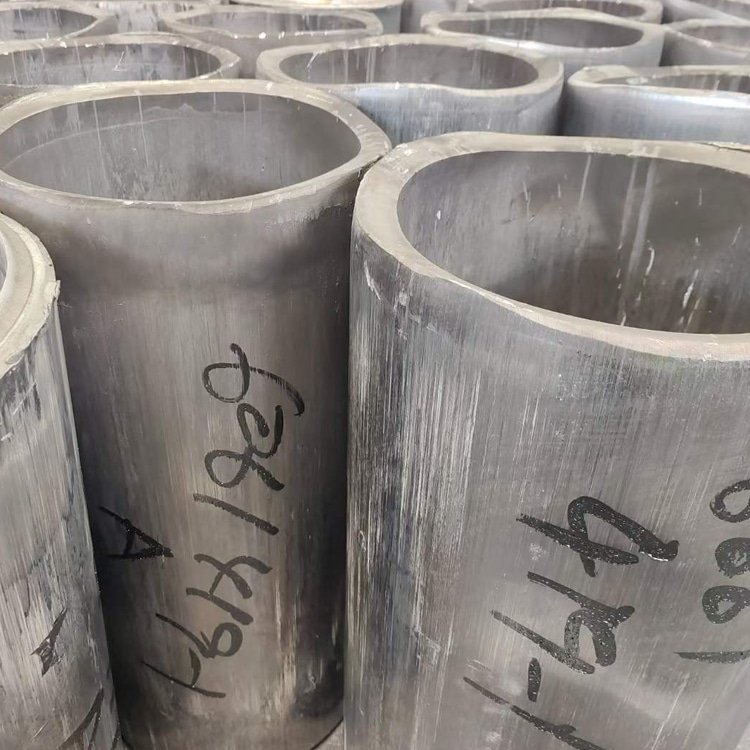
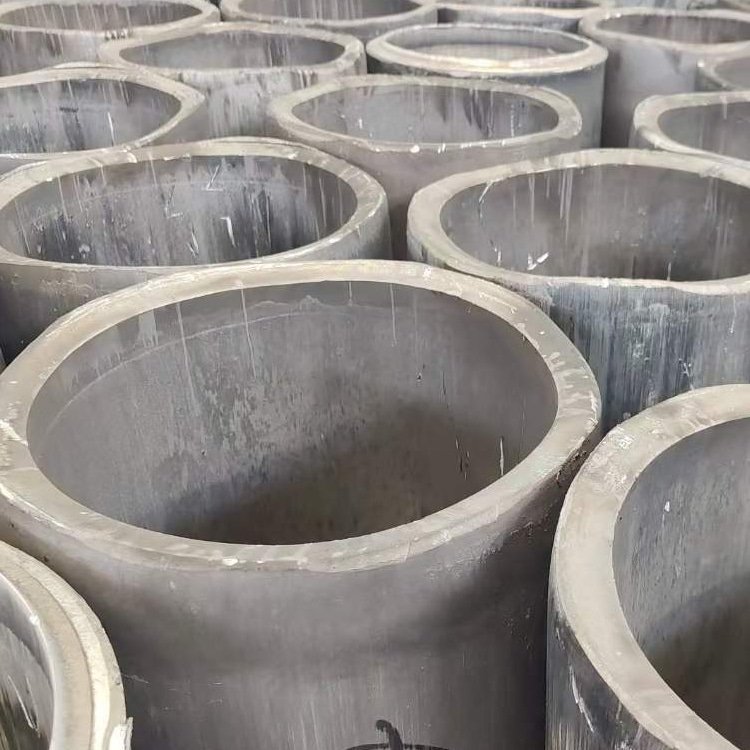
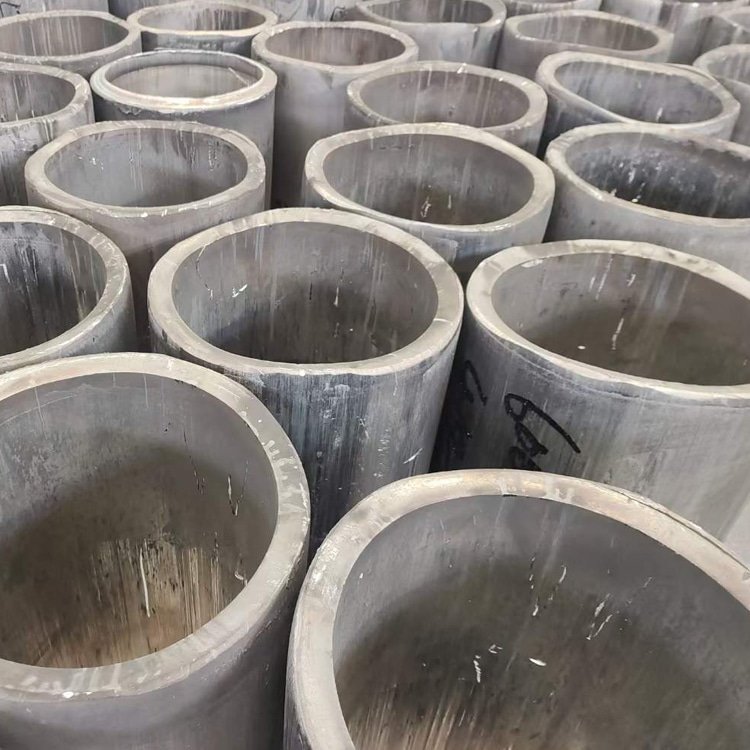
1. Material Composition & Manufacturing Process
6061 aluminum alloy (ASTM B241, AMS 4025) large diameter tubes feature a balanced magnesium-silicon composition optimized for structural integrity and fabrication flexibility:
- Alloy Chemistry:
- Magnesium (Mg): 0.8-1.2% (solution strengthening)
- Silicon (Si): 0.4-0.8% (precipitation hardening)
- Copper (Cu): 0.15-0.40% (enhanced machinability)
- Chromium (Cr): 0.04-0.35% (grain refinement)
- Base Material:
- Aluminum (Al): ≥97.5% (balance)
- Controlled Impurities:
- Iron (Fe): ≤0.7% max
- Manganese (Mn): ≤0.15% max
- Zinc (Zn): ≤0.25% max
- Titanium (Ti): ≤0.15% max
Advanced Manufacturing Process:
- Hot Extrusion: 480-520°C at extrusion ratios of 10:1 to 30:1
- Cold Drawing: 10-20% reduction for dimensional accuracy
- Stretch Straightening: 1.5-3% elongation for stress relief
- Heat Treatment: T4/T6 temper options
- Surface Finishing: Anodizing or chemical conversion coatings
Certified to AMS-QQ-A-200/9 and EN 755-7 standards with full material traceability systems.
2. Mechanical Properties for Structural Applications
| Property | T4 Temper | T6 Temper | Test Standard |
| Ultimate Tensile Strength | 180-215 MPa | 260-310 MPa | ASTM E8 |
| Yield Strength (Rp0.2) | 110-130 MPa | 240-280 MPa | ASTM E8 |
| Elongation (%) | 16-22% | 10-15% | ASTM E8 |
| Shear Strength | 125-145 MPa | 170-200 MPa | ASTM B769 |
| Bearing Strength | 365-415 MPa | 480-550 MPa | ASTM E238 |
| Fatigue Strength (10⁷) | 75-95 MPa | 90-115 MPa | ASTM E466 |
| Hardness (Brinell) | 65-75 HB | 95-105 HB | ASTM E10 |
| Impact Toughness | 20-25 J | 16-20 J | ASTM E23 |
Maintains 85% of mechanical properties at temperatures from -50°C to 150°C.
3. Heat Treatment & Microstructure Control
Temper Processing Options:
- T4 Solution Treatment:
- Heating: 530°C ±5°C for 1-2 hours
- Quenching: Water spray (cooling rate >200°C/min)
- Natural aging: 96+ hours at ambient
- T6 Full Hardening:
- Solution treatment: Same as T4
- Artificial aging: 160-180°C for 8-12 hours
Microstructural Characteristics:
- Primary Phases: β-Mg₂Si precipitates
- Grain Structure: ASTM 5-7 (30-60μm)
- Precipitate Size:
- T4 condition: 2-10nm GP zones
- T6 condition: 50-200nm β" needles
- Dislocation Density: 5-7×10⁹/cm²
- Recrystallization Fraction: 70-90%
4. Dimensional Specifications for Large Tubing
| Parameter | Standard Range | Precision Tolerance | Special Capabilities |
| Outer Diameter | 150-1000 mm | ±0.15% OD | Up to 1800 mm |
| Wall Thickness | 5-40 mm | ±10% WT | 2.5-60 mm available |
| Length | 3-20 m | +15mm/-0mm | Up to 25m sections |
| Ovality | ≤0.6% | ≤0.2% (critical) | - |
| Straightness | 1.2 mm/m | 0.4 mm/m | - |
| Perpendicularity | ≤1.0° | ≤0.5° | - |
| Wall Runout | ≤0.8% TIR | ≤0.3% TIR | - |
Forming Capabilities:
- Rotary Swaging for end forming
- Mandrel Bending (R/D ratios down to 3:1)
- Flange Roll Forming
- Localized Annealing for complex shapes
- Expansion/Reduction Operations
5. Corrosion Resistance & Environmental Durability
| Environment | Performance Rating | Corrosion Rate | Protection Methods |
| Marine Atmosphere | Excellent | <0.001 mm/year | Alodine 1200S conversion |
| Industrial Atmosphere | Good | 0.002-0.005 mm/year | Chromic acid anodizing |
| Fresh Water | Excellent | Negligible pitting | Powder coating |
| Chemical Exposure | Fair-Good | Varies by chemical | PTFE coating |
| Stress Corrosion | Excellent | SCC threshold >75MPa | T73 overaged temper option |
Surface Treatment Options:
- Anodizing (Type II): 5-25μm thickness
- Powder Coating: 60-120μm thickness
- PVDF Coating: Weather-resistant finish
- Electrophoretic Deposition: Uniform coverage
- Chemical Film Coating: Chromate-free options
6. Machining & Fabrication Performance
| Operation | Tool Material | Recommended Parameters | Surface Quality |
| Turning | Carbide inserts | 200-350 m/min, 0.1-0.3mm/rev | Ra 0.8-2.0 μm |
| Drilling | HSS drills | 30-70 m/min, 0.05-0.15mm/rev | ±0.05 mm hole size |
| Milling | PCD cutters | 500-800 m/min | Ra 0.4-1.5 μm |
| Reaming | Carbide tipped | 20-50 m/min | IT7 tolerance |
| Tapping | Coated HSS taps | 10-15 m/min | 6H thread quality |
Fabrication Advantages:
- Weldability: Excellent (ER4043 filler)
- Formability: High (min bend radius = 2.5T)
- Brazeability: Good with proper flux
- Shear and Punch: Low tool wear
- Polishing Response: Mirror finish achievable
7. Welding & Joining Technologies
Preferred Welding Methods:
- Gas Metal Arc Welding (GMAW):
- Wire: ER4043/ER5356
- Parameters: 19-23V, 150-220A
- Friction Stir Welding (FSW):
- Tool Speed: 400-800 RPM
- Travel Speed: 120-250 mm/min
- Tungsten Inert Gas (TIG):
- Purity: 99.996% Argon
- Electrode: 2% thoriated
Specialized Joining Systems:
- Mechanical Fastening:
- Hi-Tigue® collars
- Rivnut® threaded inserts
- Adhesive Bonding:
- Epoxy structural adhesives (20-30MPa)
- Methacrylate systems (15-25MPa)
- Brazing Processes:
- Vacuum brazing: 590-620°C
- Flame brazing with aluminum-silicon fillers
8. Physical Properties for Design Applications
| Property | Value | Design Significance |
| Density | 2.70 g/cm³ | Weight reduction advantage |
| Young's Modulus | 68.9 GPa | Stiffness optimization |
| Poisson's Ratio | 0.33 | Stress distribution control |
| CTE (20-100°C) | 23.6 μm/m·°C | Thermal expansion matching |
| Thermal Conductivity | 167 W/m·K | Heat dissipation capability |
| Electrical Conductivity | 40% IACS | Electromagnetic properties |
| Melting Range | 582-652°C | Processing parameters |
| Magnetic Permeability | 1.00002 | EM transparency |
9. Quality Control & Certification
Comprehensive Testing:
- Ultrasonic Testing: ASTM E588 standard
- Hydrostatic Testing: 1.5x design pressure
- Dye Penetrant Inspection: ASTM E1417
- Tensile Testing: Each 500kg batch
- Chemical Analysis: Optical emission spectrometry
Certification Standards:
- ISO 9001:2015 Certified
- AS9100 Aerospace Quality
- PED 2014/68/EU Compliance
- NACE MR0175/ISO 15156
- AWS D1.2 Structural Welding Code
- NADCAP Accredited Processing
10. Industry Applications & Handling
Primary Application Sectors:
- Construction structural framing
- Material handling systems
- Marine components and railings
- Agricultural equipment frames
- Renewable energy structures
- Industrial machinery guarding
- Transportation equipment
- Architectural elements
Handling & Storage Protocols:
- End caps for protection
- Horizontal storage on V-blocks
- Wood spacers for stacking
- Protective film covering
- Climate-controlled storage for T6 temper
- VCI paper wrapping for long-term storage
Packaging Specifications:
- Plastic sheeting + desiccant packs
- Custom-fitted wooden crates
- UV-resistant shrink wrapping
- Non-metallic banding systems
- Corner protectors for safe transport