
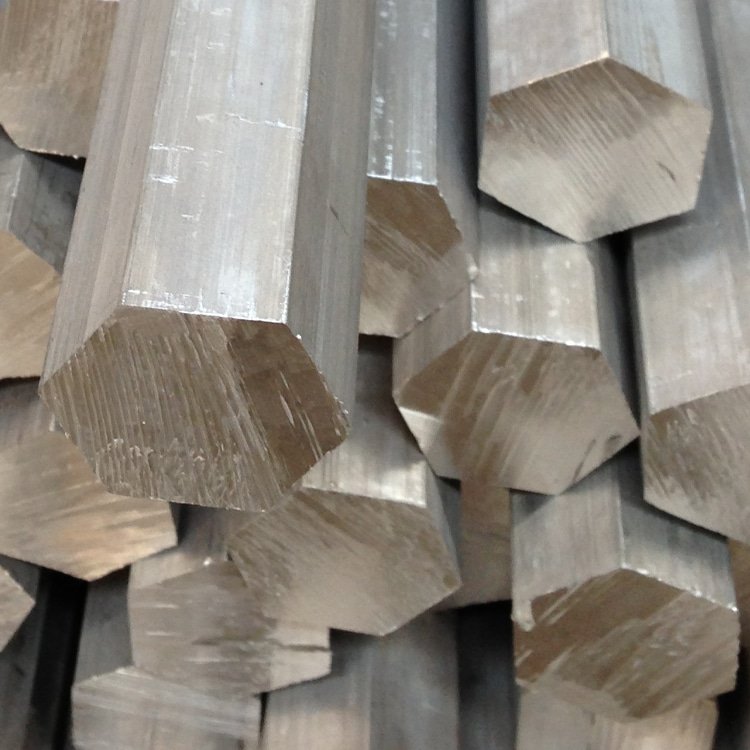

1. Material Composition & Manufacturing Process
6063 aluminum alloy (AlMgSi0.5) is a medium-strength alloy with excellent extrudability, surface finish, and corrosion resistance. This popular architectural alloy combines good mechanical properties with superior formability and anodizing response:
- Primary Alloying Elements:
- Magnesium (Mg): 0.45-0.90% (precipitation hardening)
- Silicon (Si): 0.20-0.60% (forms Mg₂Si strengthening precipitates)
- Base Material:
- Aluminum (Al): ≥98.0% (balance)
- Controlled Impurities:
- Iron (Fe): ≤0.35% max
- Copper (Cu): ≤0.10% max
- Manganese (Mn): ≤0.10% max
- Chromium (Cr): ≤0.10% max
- Zinc (Zn): ≤0.10% max
- Titanium (Ti): ≤0.10% max
- Other elements: ≤0.05% each, ≤0.15% total
Premium Extrusion Manufacturing Process:
- Billet Preparation:
- High-purity primary aluminum (99.7% minimum)
- Precise alloying element additions
- Degassing treatment (hydrogen < 0.2 ml/100g)
- Direct-chill (DC) semi-continuous casting
- Homogenization at 560-580°C for 4-8 hours
- Billet Preheating:
- Computer-controlled heating to 450-480°C
- Temperature uniformity: ±5°C
- Oxide layer removal (scalping)
- Extrusion:
- Breakthrough pressure: 35-45 MPa
- Running pressure: 20-35 MPa
- Ram speed: 5-15 mm/sec (profile-dependent)
- Exit temperature control: 510-540°C
- Die temperature: 480-500°C
- Cooling:
- Air cooling or water quenching (temper-dependent)
- Controlled cooling rate for optimal properties
- Maximum distortion control
- Stretching:
- 5-2.0% permanent deformation
- Straightening and stress relief
- Artificial Aging (T5/T6):
- T5: 175-185°C for 2-4 hours
- T6: Solution heat treatment (520-530°C) + Artificial aging (175-185°C for 6-8 hours)
- Finishing Operations:
- Cut-to-length precision: ±1mm
- Surface finish enhancement
- Final straightness check and correction
All manufacturing maintains digital process monitoring for complete traceability.
2. Mechanical Properties of 6063 Extruded Bar
| Property | T5 (min) | T5 (typical) | T6 (min) | T6 (typical) | Test Method |
| Ultimate Tensile Strength | 150 MPa | 160-185 MPa | 205 MPa | 215-230 MPa | ASTM E8 |
| Yield Strength (0.2%) | 110 MPa | 120-145 MPa | 170 MPa | 180-200 MPa | ASTM E8 |
| Elongation (2 inch) | 8% | 10-14% | 8% | 10-12% | ASTM E8 |
| Hardness (Brinell) | 60 HB | 65-75 HB | 75 HB | 80-90 HB | ASTM E10 |
| Fatigue Strength (5×10⁸) | 70 MPa | 75-85 MPa | 95 MPa | 100-110 MPa | ASTM E466 |
| Shear Strength | 90 MPa | 95-110 MPa | 120 MPa | 125-140 MPa | ASTM B769 |
| Modulus of Elasticity | 69.5 GPa | 69.5 GPa | 69.5 GPa | 69.5 GPa | ASTM E111 |
Property Distribution:
- Longitudinal to transverse property ratio: 1.00:0.95
- Wall thickness effect: <5% variation for up to 10mm thickness
- Corner to flat section property variation: <10%
- Surface to core hardness variation: <5 HB
3. Surface Finish & Appearance
Surface Quality Classifications:
- Architectural Grade (AA10):
- Ra ≤ 0.4μm surface roughness
- No visible defects at 1m viewing distance
- Suitable for decorative anodizing
- Consistent color after anodizing
- Commercial Grade (AA20):
- Ra ≤ 0.8μm surface roughness
- Minor defects acceptable at >2m viewing distance
- Good anodizing response
- Industrial Grade (AA30):
- Ra ≤ 1.6μm surface roughness
- Functional applications where appearance is secondary
Surface Treatment Compatibility:
- Anodizing Response: Excellent
- Type II (sulfuric acid): 5-25μm thickness
- Type III (hard coat): 25-75μm thickness
- Color consistency rating: Excellent
- Architectural Class I: 18μm minimum coating
- Architectural Class II: 10μm minimum coating
- Mechanical Finishing:
- Brushing/Polishing: Excellent response
- Bead blasting: Uniform matte finish
- Bright dipping: High reflectivity achievable
- Painting/Coating:
- Powder coating adhesion: Excellent
- Wet paint compatibility: Good with proper pretreatment
- Chromate conversion coating: Class 1A achievable
4. Dimensional Specifications & Tolerances
| Parameter | Standard Range | Precision Tolerance | Commercial Tolerance | Test Method |
| Diameter (Round) | 5-300 mm | ±0.15mm up to 30mm | ±0.25mm up to 30mm | Micrometer |
| ±0.3% above 30mm | ±0.5% above 30mm | |||
| Width (Rectangle) | 10-200 mm | ±0.15mm up to 50mm | ±0.25mm up to 50mm | Caliper |
| ±0.3% above 50mm | ±0.5% above 50mm | |||
| Length | 1000-6500 mm | ±2mm | ±5mm | Tape measure |
| Straightness | N/A | 0.3mm/m | 0.5mm/m | Straightedge |
| Twist (Rectangular) | N/A | 1° max per meter | 3° max per meter | Protractor |
| Corner Radius | N/A | ±0.2mm | ±0.5mm | Radius gauge |
Standard Available Forms:
- Round Bar: Diameters 5-300mm
- Hexagonal Bar: Across flats 8-75mm
- Square Bar: Side dimensions 5-150mm
- Rectangular Bar: Width up to 200mm, thickness from 3mm
- Custom profiles available with appropriate tooling
5. Temper Designations & Heat Treatment Options
| Temper Code | Process Description | Optimal Applications | Key Characteristics |
| T1 | Cooled from extrusion and naturally aged | Non-critical applications | Moderate strength, excellent formability |
| T4 | Solution heat treated and naturally aged | Forming applications | Good formability, moderate strength |
| T5 | Cooled from extrusion and artificially aged | General purpose | Good strength, excellent extrudability |
| T6 | Solution heat treated and artificially aged | Structural applications | Maximum strength and hardness |
| T52 | Cooled from extrusion, stress relieved, artificially aged | Length-critical applications | Improved straightness, good strength |
| T83 | Solution heat treated, cold worked, artificially aged | High-stress applications | Enhanced strength with good toughness |
Temper Selection Guidance:
- T5: Most economical for standard applications
- T6: When maximum strength is required
- T4: When post-extrusion forming is needed
- T52: For applications requiring strict dimensional stability
6. Machining & Fabrication Characteristics
| Operation | Tool Material | Recommended Parameters | Comments |
| Turning | HSS, Carbide | Vc=200-500 m/min, f=0.1-0.4 mm/rev | Excellent surface finish |
| Drilling | HSS, Carbide | Vc=80-150 m/min, f=0.15-0.3 mm/rev | Low cutting forces |
| Milling | HSS, Carbide | Vc=200-600 m/min, fz=0.1-0.25 mm | Excellent chip evacuation |
| Tapping | HSS, TiN coated | Vc=10-30 m/min | Excellent thread quality |
| Sawing | Carbide tipped | Vc=800-1500 m/min, medium pitch | Clean cuts with minimal burr |
| Threading | HSS, Carbide | Vc=150-300 m/min, fine feed | Excellent thread finish |
Fabrication Guidance:
- Machinability Rating: 90% (1100 aluminum = 100%)
- Surface Finish: Excellent (Ra 0.5-1.6μm easily achievable)
- Chip Formation: Short chips with proper tooling
- Coolant: Water-soluble emulsion or minimal lubrication
- Tool Wear: Minimal with proper parameters
- Formability: Excellent in T1/T4 conditions
- Bendability: Minimum radius = 1× thickness (T1/T4), 2× thickness (T6)
- Weldability: Good with TIG/MIG methods
- Thread Rolling: Excellent results in T4 condition
7. Corrosion Resistance & Protection Systems
| Environment Type | Resistance Rating | Protection Method | Expected Performance |
| Rural/Urban Atmosphere | Excellent | Mill finish or anodizing | 15-20+ years |
| Industrial Atmosphere | Very Good | Anodizing Class I | 10-15 years |
| Marine Environment | Good | Anodizing + sealing | 5-10 years with maintenance |
| High Humidity | Excellent | Standard anodizing | 10-15 years |
| Chemical Exposure | Moderate | Hard anodizing + sealing | Application specific |
| UV Exposure | Excellent | Clear anodizing | No degradation |
Surface Protection Options:
- Anodizing:
- Clear (natural): Excellent clarity and transparency
- Color anodizing: Consistent color development
- Hard anodizing: Superior wear resistance
- Sealing options: Hot water, nickel acetate, PTFE
- Conversion Coatings:
- Chromate per MIL-DTL-5541
- Non-chromium alternatives
- Mechanical Finishing:
- Brushed finish: Uniform directional pattern
- Polished finish: Mirror-like appearance achievable
- Sandblasted: Consistent matte texture
- Organic Coatings:
- Powder coating: Excellent adhesion and durability
- Liquid paint: Good with proper pretreatment
- Clear protective coatings: UV and abrasion protection
8. Physical Properties for Engineering Design
| Property | Value | Design Consideration |
| Density | 2.70 g/cm³ | Weight calculation for components |
| Melting Range | 615-655°C | Thermal processing limitations |
| Thermal Conductivity | 200-220 W/m·K | Heat sink applications |
| Electrical Conductivity | 50-55% IACS | Electrical applications |
| Specific Heat | 900 J/kg·K | Thermal mass calculations |
| Thermal Expansion (CTE) | 23.4 ×10⁻⁶/K | Thermal expansion allowances |
| Young's Modulus | 69.5 GPa | Structural calculations |
| Poisson's Ratio | 0.33 | Structural analysis parameter |
| Reflectivity | 80-85% (polished) | Optical/lighting applications |
Design Considerations:
- Operating Temperature Range: -80°C to +175°C
- Property Retention: Excellent below 100°C
- Electrical Conductivity: Higher than many aluminum alloys
- Magnetic Properties: Non-magnetic
- Recyclability: 100% recyclable, high scrap value
- Environmental Impact: Low carbon footprint compared to steel
9. Quality Assurance & Testing
Standard Testing Procedures:
- Chemical Composition:
- Optical emission spectroscopy
- Verification of all major elements and impurities
- Mechanical Testing:
- Tensile testing (longitudinal)
- Hardness testing (Webster/Brinell)
- Dimensional Inspection:
- Diameter/dimensions at multiple locations
- Straightness verification
- Surface finish measurement
- Visual Inspection:
- Surface defects assessment
- Die line evaluation
- Surface appearance uniformity
- Specialized Testing (When Required):
- Anodizing response test
- Grain structure evaluation
- Conductivity testing
Standard Certifications:
- Mill Test Report per EN 10204 2.1/3.1
- Chemical analysis certification
- Mechanical properties certification
- Dimensional inspection report
- Heat treatment certification (for T6 temper)
10. Applications & Design Considerations
Primary Applications:
- Architectural components:
- Window and door frames
- Curtain wall systems
- Railings and balustrades
- Decorative trim and moldings
- Transportation:
- Automotive trim and components
- RV and trailer components
- Bicycle frames and components
- Electrical:
- Heat sinks and thermal management
- Electrical enclosures and housings
- LED lighting fixtures and profiles
- Consumer goods:
- Furniture components
- Appliance trim and parts
- Shower enclosures and bathroom accessories
- Industrial components:
- Pneumatic cylinder tubes
- Machine guards and frames
- Conveyors and material handling
Design Advantages:
- Excellent surface finish for aesthetic applications
- Superior extrudability for complex profiles
- Good strength-to-weight ratio
- Excellent corrosion resistance
- Outstanding anodizing response
- Ease of fabrication and joining
- Cost-effective compared to higher-strength alloys
- Consistent properties and quality
- Readily available in diverse shapes and sizes
- Sustainable material with high recycled content potential
Design Limitations:
- Lower strength compared to 6061/6082 alloys
- Not recommended for highly stressed structural applications
- Limited weldability compared to 6061
- Reduced mechanical properties in weld heat-affected zones
- Temperature limitations above 175°C
Economic Considerations:
- Excellent balance of cost and performance
- Lower processing costs than higher-strength alloys
- Reduced machining costs due to excellent machinability
- Long service life with minimal maintenance
- High scrap value at end of life cycle