Skip to content
You receive a shipment of aluminum, but without a test certificate, you have no proof of its quality. This creates a huge risk that the material will fail, damaging your reputation and your bottom line.
Testing isn't about finding data; it's about creating trust. The test certificate is a Rosetta Stone—it translates the silent language of metallurgy into the universal language of business: a binding promise of performance and a guarantee against risk.
A few years ago, we supplied a large order of 6061-T61 forged rings to a trading partner in the Middle East. They, in turn, sold them to a local CNC machining company. The end-user was skeptical; they had received bad material from a different supplier before and were wary. They questioned if our material was truly T6 temper. Instead of a long dispute, our client simply forwarded the product quality certificate we provided with the shipment. The certificate clearly listed the results of the hardness and tensile strength tests, proving it met the T6 standard. The issue was resolved in five minutes. That certificate wasn't just a piece of paper; it was a tool that maintained the trust between our client and their customer, and it saved them weeks of potential delays and arguments. It proved the value of our promise.
How do you test the hardness of aluminum alloy?
You need to verify that the aluminum you received has the correct temper and hardness. Without the right tools, you are just guessing, and a soft part could lead to catastrophic failure.
Aluminum hardness is measured using a specialized machine that presses a hard indenter into the material's surface. The size of the resulting impression is measured to calculate a hardness value, typically using the Brinell (HB) or Rockwell (HRB) scale.

This is a fundamental part of our quality control process for every forged part we produce. For large forged rings and discs, the Brinell hardness test (HBW) is the industry standard. The test itself is simple in concept: we apply a known force (e.g., 500 kgf) using a tungsten carbide ball of a specific diameter (e.g., 10 mm) for a set time. After we remove the force, we measure the diameter of the permanent dent left in the material. A smaller dent means a harder material. This test is non-destructive for large parts and gives a reliable indication of the material's temper and machinability. A harder material like 7075-T62 will have a higher HB value and will be more challenging to machine than a softer 6061-T6. For our clients, the hardness value on our certificate is a direct confirmation that they have received the exact temper they ordered and that the material will perform as expected in their machines and in the final application.
Typical Hardness Values
| Alloy & Temper | Typical Brinell Hardness (HBW) | What This Means for You |
|---|---|---|
| 6061-T6 | ~95 | Good hardness, excellent machinability. |
| 6082-T6 | ~95 | Similar to 6061, with slightly better corrosion resistance. |
| 7075-T6 | ~150 | Very high hardness, more challenging to machine, requires slower speeds. |
| 5083-H111 | ~70 | Softer, tougher, not hardenable by heat. Good for welding. |
How can you tell if aluminum is 6061 or 7075?
You have two unmarked pieces of aluminum. One is 6061, the other is 7075. Visually, they are identical, but using the wrong one could mean the difference between success and failure for your part.
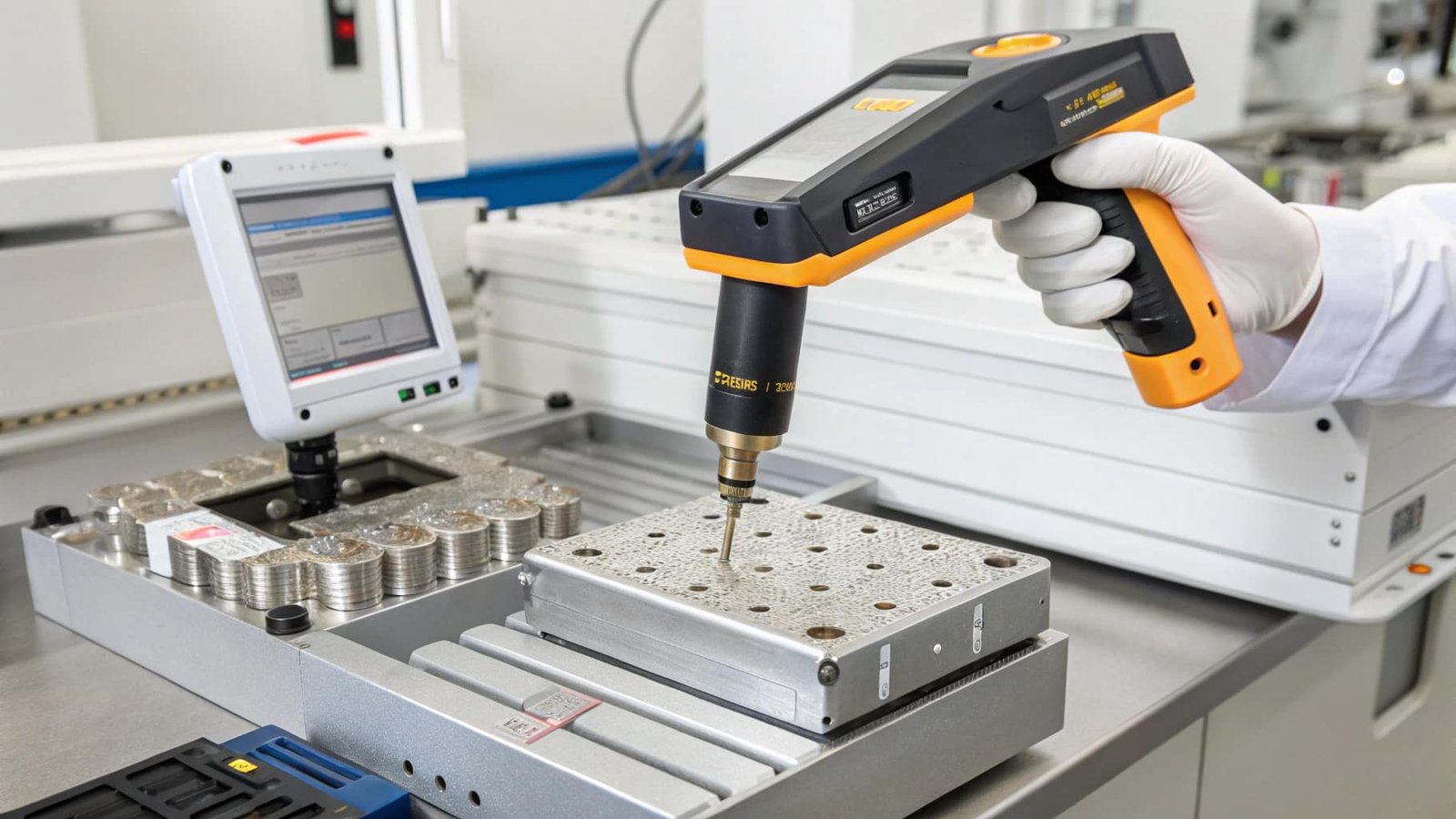
Without lab equipment, you cannot reliably distinguish between 6061 and 7075. The only true way to know is through certified documentation from the supplier or by using a specialized material analyzer like a portable XRF gun.

This is one of the biggest "hidden risks" in the metal supply chain. Visually, there is no difference. Both are silver-colored metals. Even an experienced machinist might only notice a subtle difference in how they cut. The only definitive way to tell them apart is to analyze their chemical composition. The 7075 alloy contains a significant amount of zinc (around 5.6%) as its primary alloying element, while 6061 uses magnesium and silicon. A portable X-Ray Fluorescence (XRF) analyzer can detect these differences in seconds. We use these tools for verification, but more importantly, our entire production process is built on traceability. From the moment a raw billet enters our facility to the final forged ring we ship, it is tracked. This is why our product quality certificate is so crucial. It's not just a claim; it's the final link in an unbroken chain of custody, guaranteeing that the 6061 you ordered is the 6061 you received. Don't ever rely on a visual guess.
Will a magnet stick to aluminum alloy?
You need a quick, simple field test to differentiate aluminum from steel. You pull a magnet from your pocket and try to stick it to the metal part.
No, a magnet will not stick to any common aluminum alloy. Aluminum is a paramagnetic material, meaning it is very weakly attracted to magnetic fields, but this force is far too weak to be detected by a standard magnet.

This is a reliable and easy test to distinguish aluminum from most steels. Steel's primary component is iron, which is a ferromagnetic material, meaning it is strongly attracted to magnets. This simple magnetic test is one of the first steps in any metal sorting yard. However, it is important to remember what the test doesn't tell you. While it can confirm that a material is likely not carbon steel, it cannot tell you anything else. Many other metals are also non-magnetic, including titanium, copper, and even certain types of stainless steel (like the 300 series). So, while the magnet test is a great "pass/fail" for identifying plain steel, it cannot determine the specific type of aluminum alloy or its quality. It's a useful trick for quick sorting, but it is not a substitute for proper material identification through certified documentation or chemical analysis. It can answer "Is this steel?" but it can never answer "Is this the 7075-T6 I ordered?"
How can you definitively determine the aluminum alloy?
You absolutely must know the exact composition of an aluminum part. A visual guess is not enough, and a magnet test is too basic. What is the professional method for identification?
The industry-standard method is Positive Material Identification (PMI) using an X-Ray Fluorescence (XRF) or Optical Emission Spectrometry (OES) analyzer. These devices accurately measure the elemental composition, providing a definitive "fingerprint" of the alloy.

As a manufacturer, we live by this data. It is the foundation of our quality promise. Here is how the different methods stack up, from least to most reliable.
Methods of Alloy Identification
| Method | Description | Reliability | Our Role |
|---|---|---|---|
| Visual/Physical Test | Looking at the color, testing with a magnet, checking the density by weight. | Very Low. Cannot distinguish between aluminum alloys. Only useful to separate aluminum from other metal families like steel. | We never rely on this. This is for scrapyard sorting, not for precision manufacturing. |
| Spark Testing | Grinding the metal on a wheel and observing the color and shape of the sparks. | Low. An old-world skill. Requires immense experience and can only offer clues. Not a reliable method for modern alloys. | Obsolete for our quality control. We need data, not interpretation. |
| Portable XRF Analysis | A handheld "gun" that bombards the metal with X-rays and reads the resulting fluorescence to determine elemental composition. | High. Very accurate for PMI in the field or warehouse. It is the go-to tool for verifying material on-site. | We use this for incoming raw material verification to ensure we are starting with the correct billet. |
| Lab Analysis (OES) | A sample is vaporized in the lab, and the light it emits is analyzed to give a highly precise chemical breakdown. | Extremely High. This is the definitive, reference-grade method used to create material certifications. | This is the method we use for our final product quality certificates. It provides the undeniable proof of composition for our clients. |
Ultimately, the burden of proof is on the supplier. Our promise to you is a product that comes with a certificate based on precise lab analysis, removing all doubt.
Conclusion
Testing creates a verifiable promise. It transforms metallurgical data into a certificate of trust, guaranteeing the performance and integrity of your material, and securing your business against risk and uncertainty.